|
TELEVISION
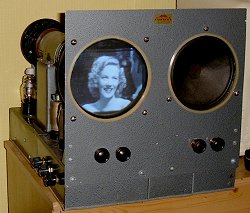
a lifetime ago - how it looked ... An unretouched picture showing BBC hostess
Elizabeth Cowell, taken from the television screen in July 1939.
|
| Long
a science-fiction dream, TELEVISION was a major technical achievement of the twentieth
century. In November 1936, the BBC started the world's first regular high-definition
television service from the Alexandra Palace in London. |
|
| |
|
Above left, dating from 1937, we see an example of the Marconiphone 702
with mirror-lid, restored to working order. The set on the right, a 1938 HMV
907 with radio, I restored some years ago but is no longer in my collection.
Unfortunately due to a recent plumbing emergency the 702 was seriously damaged
but now it has been fully restored (both cabinet and electronics) in the Radiocraft
workshop ! You can follow this process HERE
|
|
| |
Above, on the left you can see a Retrovisor Festival, produced by Radiocraft
from 1993 to 1995. In the centre there's an original example of its inspiration
- the Bush TV22 which dates from 1950. Finally, on the right there's a
Retrovisor Metropolis in operation.
Interested
in finding out more about the Retrovisor ? Click HERE
to take a look at these sets and learn the current supply situation. |
|
| |
|
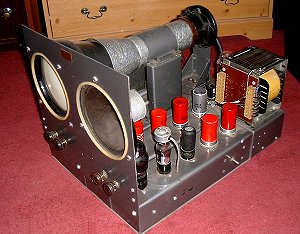
This is the Argus, a 'kit' television I constructed in 1990 from instructions
which appeared in a series of Practical Television Magazines in 1952. Billed as
a "television for £20" I found this still cost about the same
to construct (in real terms allowing for inflation) 38 years later. It uses 1940s-style
trf circuitry and ex-WD parts. Although the VCR97 tube originally specified gave
a green picture, I was fortunate enough to find a physically-identical CV2810.
This had a short persistence violet phosphor beneath a longer persistence green
one, effectively giving a black & white picture.
As the post-war austerity period was drawing to a close, this project allowed
the technically-minded amateur to build his own set for an affordable price. Specially
designed cabinets for this chassis were also made available at the time. If
you'd like to build your own Argus, CLICK HERE
for all the original instructions ! | |
|
|
|
|
|
|
|
|
|
|
|
|
| |
VINTAGE
TELEVISION LINKS
|

|
|
|
|
| | SPECIAL
PROJECTS | RADIOCRAFT
| GUEST
BOOK | MORE
INFO | GET
IN TOUCH | |